
Have your hands been in ‘communication lock down’ for the past 2 years? Resting gently on your desk while you Zoom your way through the business day. Perhaps cradling a comforting warm beverage. Well, it’s time to put them into action again as one of your strongest communication tools. It’s crazy how quickly we forget things, and now that many of us are returning to an office environment, and therefore, in-person meetings, a question we’re frequently being asked from presenters is “What do I do with my hands?”.
When you think about it, this could seem like an odd question – what to do with your hands when presenting – because we communicate all the time, day in and day out, and we never even think about what we are doing with our hands. That is, of course, until we stand up. For many of us the minute we stand up our arms and hands become like foreign objects. We don’t know whether to cross them, have them dangling by our side, or put them in our pockets!
Body language, as we all know, is incredibly important for helping us get our message across. No, it doesn’t account for 93% of the way that we communicate like many people mistakenly report – if you want to explore this further you might like our blog which mentions the Mehrabian myth – but how we use our hands is none-the-less extremely important. Gestures are a wonderful way to convey energy, tell a story, emphasise a message and bring your ideas to life.
A study by Holler and Beatie found that gestures increase the value of our spoken message by a massive 60%, and the most acclaimed ‘Ted Talkers’ use twice as many hand gestures as those with a lower appreciation score. But the rest of us most commonly tend to use gestures not to add to our message but when we can’t find the right words to make our point. So, when you prepare your presentation think about not just what you want to say but also how you might add gestures to amplify key points and engage more effectively with your audience.
In this blog we are going to guide you through some of the most effective and persuasive hand gestures that you can use during your presentations. When used correctly they essentially give you another, simultaneous way – a second language if you like – with which to communicate and emphasise your message.
But there are also some definite ‘no no’s’, so let’s briefly look at some of the most common mistakes people make when they gesture.
Don’t do this…
- Stand At Ease. Both hands are held behind the back in military fashion and out of view. You might think that you appear confident and in control, but in fact there are a few interpretations for this gesture, and they are almost all negative (unless of course you are a member of The Royal Family), especially in a presentation setting. The audience will be wondering What are you hiding? And if we explore our tribal ancestry, we find that this stance was likely to invoke a high degree of anxiety if used by someone approaching that we didn’t know; Are they concealing a gift, or a weapon?
- The Toy Soldier. Also known as the wooden soldier, this presenter has both hands at the sides. This stance looks ridged and uncomfortable. If you find yourself in this position, move out of it quickly or else you’ll look stiff – even scared, and unapproachable.
- Fig leaf Position. This is where you clasp your hands in front of you, with your hands below your waist. We see this a lot when we work with female presenters. This position will make you appear passive, weak, and subordinate. It certainly does not communicate confidence or authority!
- Hands in Pockets. Having one hand in your pocket for a short period of time can make you look relaxed and comfortable. But if you leave it there too long it can also make you appear as if you don’t really care. Also, depending on the formality of the situation, or the culture you’re in, it can be interpreted as rude and disrespectful. There are very few people that can get away with having two hands in their pockets. For the rest of us it makes us look juvenile. AND, whatever you do, don’t be tempted to fiddle with anything that might be in your pockets e.g. coins or keys.
- The Juggler or Jazz hands. This is where your hands are in perpetual motion and never come to a stop. The overall impression you convey is one of nervousness. It’s also very distracting to watch.
- Finger Pointing. Beware of pointing at the audience. A pointing finger can be perceived as accusatory, or aggressive. Instead, use an open-handed gesture to refer to an audience member. It’s warmer and more neutral.
- Fidgeting. Overall fidgeting, be it with a ring on your finger, a necklace or lanyard, your hair, your clothing – whatever it might be, communicates nervousness. The good news though is that fidgeting can be your body’s way of telling you to move your hands – but with purpose. So, stop holding back and GESTURE, but do so effectively.
Do this…
These ‘handy’ tips are what to do with your hands when presenting:

- Hands Above the Waist. As soon as possible, bring your hands above the waist. This will help to amplify your personal presence and the impression of confidence. Your ‘power space’ is between your waist and your face. Keep most of your gestures in this box. When Bill Clinton was running for president, he used too many wide, sweeping gestures that made him look untrustworthy. His coaches told him to gesture within the box. It became known as the Clinton box.

- Find your Neutral Position. When you start flailing and over gesticulating, it’s time to come to a stop. Find a resting position, or what we refer to as a neutral position, one that you can come back to and re-set. It may be one hand on top of the other with your elbows at your waist. Or where your hands are loosely clasped, again elbows at your waist. Or in the steeple position – see below. Think of the resting or neutral position as your home base. You can continue to return to it when you feel your hands are moving too much or you need to take a pause or perhaps listen to a question. A good tip is to take a selfie of yourself in your neutral position so you can gauge what looks, and feels, the most natural for you. Remember that you will only use the neutral position for short periods of time; holding it too long will look, and certainly feel, uncomfortable.

- Steepling. Position your hands at waist level and bring your hands together with just the fingertips touching. This posture communicates confidence and can also convey authority and dial up your gravitas. Use this gesture sparingly as it can also be meant to intimidate or establish dominance.

- Hold the Ball. A powerful position is to hold your hands above the waist as if you’re holding a basketball. This gesture is a great way to let your audience know you’re ready to start your presentation, or that you’re about to enter a new chapter of your story. It’s almost like an inhalation of breath. Steve Jobs used this gesture very effectively during his presentations for Apple.
- Count Off. When you have 3-5 items you want to run through, be they agenda items, alternative solutions, strategic pillars, or whatever – you can tick off the points on your fingers as if you’re going through a list. This is a very effective way of visually chunking up your message which in turn will make what you’re about to say easier to follow for your audience.

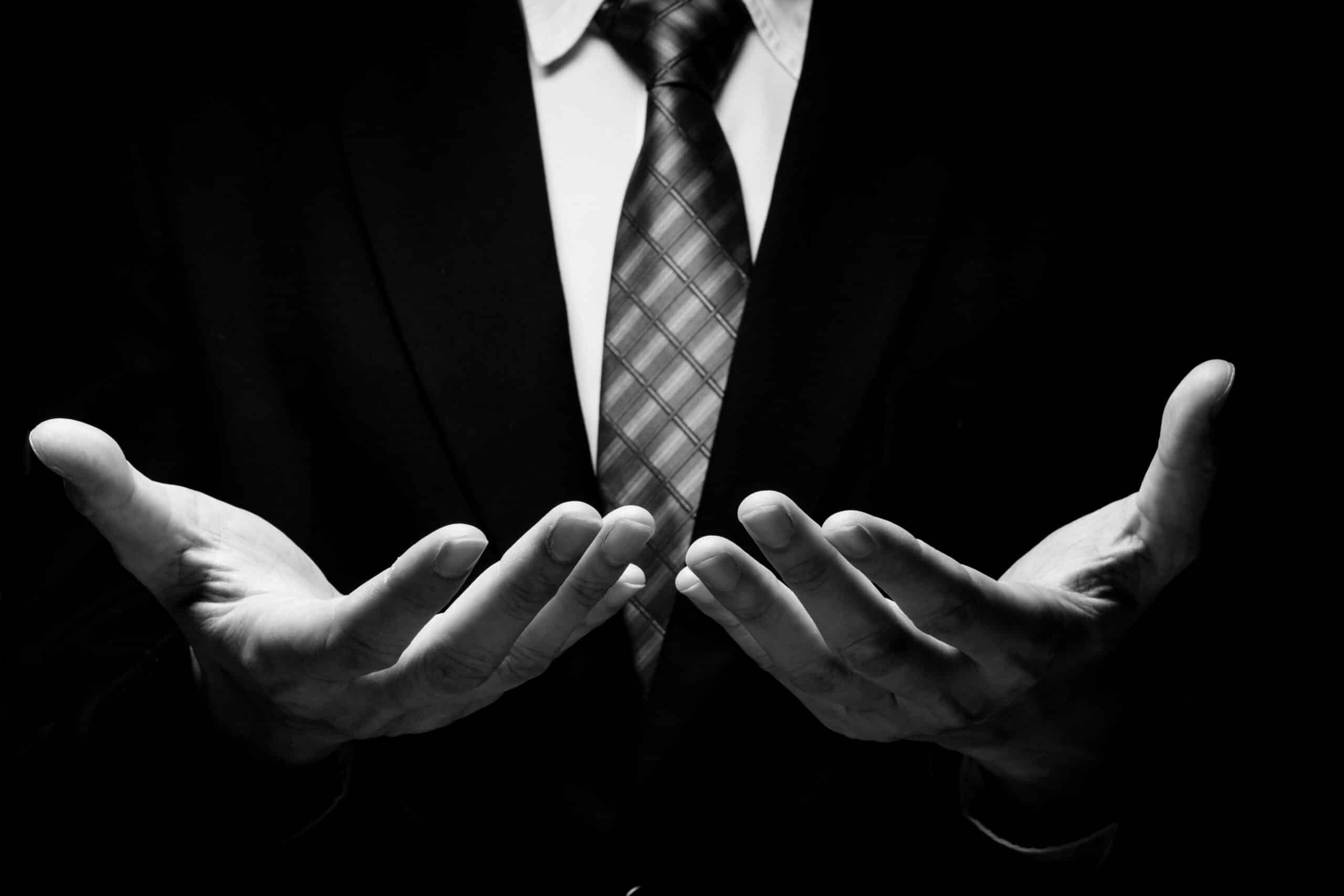
- Palms Up. To convey honesty, hold your hands waist high and turn your palms up. The reason this gesture helps to signal honesty is because by exposing the palms of your hands you’re showing that you have nothing to hide. Importantly, don’t shrug your shoulders at the same time or you’ll look unsure!
- Palms Down. Keep your palms waist high and turn your palms down so that the tops of your hands are visible. Now make a downward movement. This conveys authority, calmness, and control – and can be a great technique to use for quieting a crowd. President Obama uses this gesture very successfully.
Consider culture when thinking about what to do with your hands when presenting.

Remember that body language has different meanings in certain cultures. For example, if you’re speaking in Brazil, do not use the A-OK hand gesture. It’s considered an obscenity. Also, realise that not all cultures value gesturing in the same way. The Mediterranean and Hispanic cultures are expressive and use a lot of gestures. But in Asia, Scandinavia, and Germanic cultures, they use fewer hand movements.
As an example of this I was recently coaching someone in Sweden. I realised very early on that the person I was coaching kept looking at my hands. To be fair I do gesture quite a lot, but I quickly realised that my gestures were a distraction for this person and so once I recognised this, I kept them to a minimum. Read your audience and work out what is working well and what isn’t, and then adjust your gestures accordingly.
Why Use Gestures?

There is research that demonstrates the impact of gestures. Harvard Business Review interviewed Professor Joep Cornelissen of Erasmus University.
Erasmus University conducted a study where they asked experienced investors to watch a video of entrepreneurs pitching a medical device. They hired actors to play the entrepreneurs. The result was that the Venture Capitalists showed more interest in the presenters who used gestures to explain the idea than when they used anecdotes, metaphors, and other rhetoric.
This flies in the face of the current emphasis on storytelling. What the researchers discovered was that gesturing made the product more concrete, helping investors to better understand the product.
Gesturing also conveys excitement, and passion is a quality that investors value. However, too much gesturing can work against the presenter, making it look like pantomime. So, use a few strategic gestures to add impact and influence to your presentations, but don’t over use them!
If you don’t know what to do with your hands when presenting and hand gestures don’t come naturally to you, do practise some of the gestures mentioned above, but try to be natural. Use these tips and try a hand gesture in all your presentations – we think you’ll feel more confident and you’ll win over your audience – hands down!
As an additional comment, specifically on body language, we’ve added this image below. We don’t know about you, but we get an immediate impression of the three of them from their body language. The woman, although smartly dressed, has adopted a passive, fig leaf stance, which to us communicates that she doesn’t really feel she has a right to be an equal and integral part of this discussion. She is a listener, not a participant.
The guy in the middle looks professional, but also comes across as slightly arrogant and overconfident. Beware the hand on hip look! And the rather sloppy looking man on the right, with his hand in his pocket, scruffy shoes and wide-legged stance immediately makes us think he is smug and overly self-assured, not someone we’d like to listen to. What do you make of them?

So, the answer to the question about what to do with your hands when presenting is to make positive hand gestures! They are just one of the tools we can use to add impact to our message when presenting in person. If you’d like to brush up on your all-round presentation skills including body language, how to use the attention triangle, eye contact, answering questions and much more, when presenting in person, then check out our recent blog Transferring your virtual presenting skills to the meeting room – a guide to in-person presenting.
Tailored and personalised presentation skills training
If you’re looking to build the presentation skills of your team (or yourself) through personalised training or coaching that is tailored to your business, we can help.
For nearly 20 years we have been the Business Presentation Skills Experts, training & coaching thousands of people in an A-Z of global blue-chip organisations – check out what they say about our programmes.
To find out more, click on one of the buttons below: