
If you watch a confident presenter in action, it’s easy to assume they’ve always been good at it. They seem comfortable in front of a room, know exactly what to say and make connecting with an audience look effortless.
But effective presenters aren’t necessarily more confident, charismatic or naturally gifted than everyone else. More often, they’ve developed a set of small habits that help them prepare well, communicate clearly and stay connected with their audience.
That’s good news if you want to improve your presentation skills, because becoming a better presenter doesn’t require you to become a different person. Nor does it mean rewriting your entire presentation, memorising a script or designing elaborate slides. Some of the most effective improvements come from simple changes you can make the very next time you present.
The ten presentation habits in this blog fall into three categories: how you prepare, how you deliver, and how you connect with your audience. Each is small enough to practise individually, but together they can make a significant difference to how clear, confident and credible you come across.
The key is not to tackle all ten at once. Choose two or three that would make the biggest difference to you and focus on those first. Once they begin to feel natural, add another.
Better presenting isn’t about changing who you are. It’s about changing what you repeatedly do.
Habits That Sharpen Your Preparation
The best presentations often start long before you stand up to speak. Good preparation gives you clarity about what you want to say, removes unnecessary content and builds the familiarity that allows you to speak with confidence and fluency when it matters.
Here are four presentation habits that can make an immediate difference.
1. Decide on Your One Key Message

Before you open the slide creation software or start thinking about content, decide what you want your audience to Think, Feel or Do as a result of your presentation.
Then ask yourself a simple question:
If they remember only one sentence, what do I want that sentence to be?
That becomes the focus for everything that follows. Every example, argument and slide should help reinforce it. If something doesn’t, ask yourself whether it really needs to be there.
This is one of the simplest ways to improve presentation skills because it forces you to prioritise your audience’s takeaway rather than including everything you could potentially tell them.
Action tip: Write your key message on a sticky note before you build a single slide and keep it visible while you prepare. Any slide that doesn’t support that sentence is a candidate for cutting.
2. Know Exactly How You’ll Start and Finish
You don’t need to script the entire presentation, but there are two moments worth writing out in full: your opening and your closing.
Your opening establishes your credibility and gives the audience a reason to pay attention. Your closing is your opportunity to reinforce the message you want them to remember and make clear what should happen next.
They can also be two of the moments when nerves are most noticeable. Knowing exactly how you intend to begin means you’re not searching for your first words under pressure. And knowing how you’ll finish helps you avoid trailing off with an uncertain “So… that’s everything from me.”
Prepare those two moments carefully. Give yourself more freedom everywhere in between.
3. Cut What Your Audience Doesn’t Need
One of the hardest presentation habits to develop is being willing to leave out good material.
When you know a subject well, everything can feel important. But more information doesn’t necessarily create a better presentation. Too much detail can bury the message you most want your audience to understand.
Go back to your key message and test your content against it. If a piece of information is interesting but not essential, move it to an appendix, save it for questions or include it in a follow-up.
A strong presentation isn’t everything you know. It’s what your audience needs to know.
4. Rehearse Out Loud, But Don’t Memorise

Reading through your slides silently can create a false sense of preparedness. It tells you what you intend to say, but not how the presentation actually sounds, whether your transitions work, or how long it will take.
Rehearse out loud and, wherever possible, standing up. You’ll quickly hear where sentences feel awkward, where ideas need more explanation, or where any sections are taking too long.
But there is an important distinction: rehearsing does not mean memorising.
A recent coaching programme illustrates this well, I think. I was working with a manager, let’s call her Nicola. Nicola was preparing for an important presentation to a potential new client. The stakes were high, but I wasn’t particularly concerned about her delivery. She was naturally engaging, articulate, credible, confident and full of positive energy. Once we had nailed the narrative, I assumed the delivery coaching would be straightforward.
I was wrong.
Because the presentation mattered so much, Nicola had rehearsed extensively, but she had rehearsed from a script. When she presented, that script seemed to take everything that was naturally engaging about her and flatten it. Her voice lost its conviction and flow, and the presentation sounded like a cardboard version of the real Nicola.
The solution was simple, although not necessarily easy: we took the script away.
Instead of trying to remember precisely what she had written, Nicola had to trust that she knew her message. The few words and images on her slides served as prompts that guided her through the narrative rather than as a script she had to reproduce.
Almost immediately, her voice came back to life. Her energy returned, her personality came through, and the message became far more compelling.
And the result? She delivered a fantastic presentation and won the business.
The lesson isn’t to rehearse less. It’s to rehearse differently. Become familiar enough with the shape and logic of your presentation that you can express the ideas naturally, rather than trying to memorise a script.
What habits improve your presentation skills?
The most effective presentation habits are often simple: define one key message, prepare your opening and closing, remove unnecessary content, and rehearse out loud without memorising a script. These habits create clarity before you present, making confident, natural delivery much easier when you’re in front of an audience.
Good preparation shouldn’t make you sound rehearsed. It should make you sound ready.
Habits That Strengthen Your Delivery
You can have a strong message and know your material inside out, but how you deliver it still matters. Your pace, pauses, and physical presence all influence how the audience perceives you, often within the first few seconds.
The good news is that confident delivery doesn’t require you to become more extroverted or performative. A few small habits can change not only how you come across, but how you feel while you’re presenting.
5. Slow Down, especially at the Start
Nerves have a habit of speeding us up. Your heart rate increases, your breathing becomes shallower, and before you know it, you’re racing through the opening you prepared so carefully.
That’s precisely when slowing down matters most.
At SecondNature, we call this Setting Up for Success. Instead of allowing nervous energy to dictate your opening, make a deliberate decision to start more slowly than feels natural. Take your position, look at the audience, pause and then begin.
A measured opening gives your audience time to tune in to you and your message. Just as importantly, it gives you time to settle into the presentation rather than feeling as though you’re trying to catch up with it.
And remember: what feels unusually slow to you will rarely sound that way to your audience. More often, it comes across as calm, controlled and assured.
Your first minute sets the pace. Don’t let your nerves set it for you.
6. Get Comfortable with the Pause
A pause is one of the simplest tools available to a presenter, and one of the most underused.
Pause after an important point to give the audience time to absorb what you’ve just said. You also signal that the point matters. At the same time, that moment of silence gives you space to breathe, collect your thoughts and decide where you’re going next.
The challenge is that silence can feel uncomfortable when you’re the person standing at the front of the room. A two-second pause can feel much longer when every pair of eyes is on you.
Resist the temptation to fill it.
Common mistake: Replacing silence with filler words such as “um”, “so” or “right”. These often creep in because presenters feel they need to keep making noise while they think.
You don’t.
A clean pause almost always sounds more confident than a filled one.
Don’t be afraid of silence. A pause doesn’t interrupt your message; it gives it room to land.
7. Let Your Body Show Confidence
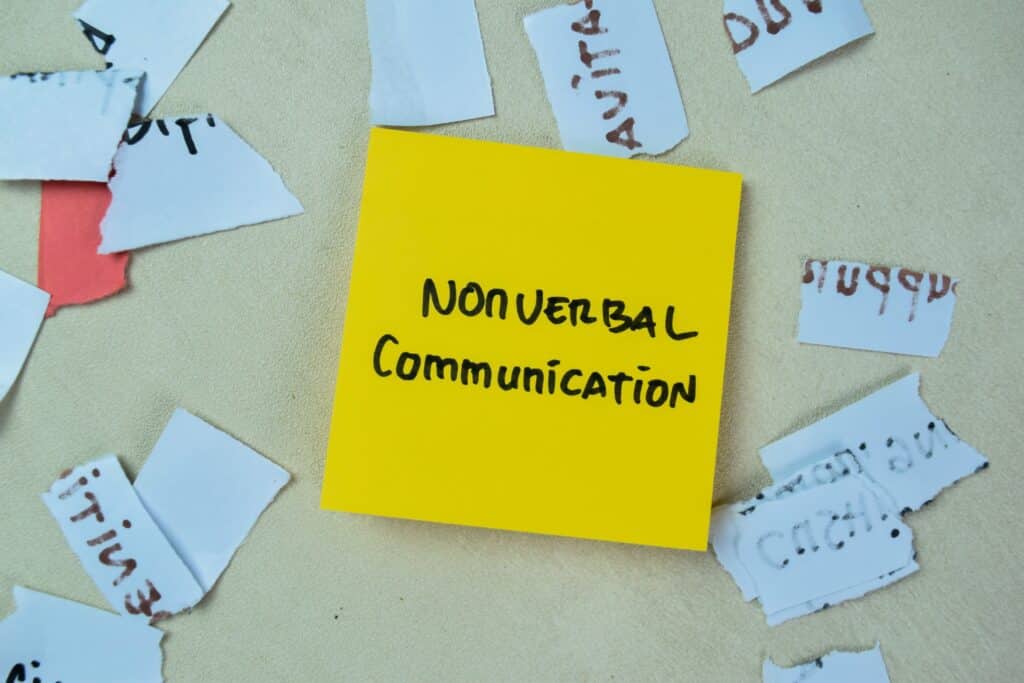
Your audience isn’t only listening to what you say. They’re also picking up cues from how you stand and move.
Aim for an open, grounded posture. Stand comfortably with your weight balanced, rather than shifting continually from one foot to the other, and let your hands gesture naturally as you speak.
Avoid gripping your notes or clasping your hands tightly. These behaviours can restrict your movement and make tension more visible.
There’s another benefit to adopting a more settled physical position: it can help you feel more settled too. Combine a grounded stance with a slower pace and deliberate pauses, and you give yourself valuable opportunities to breathe and manage some of the physical symptoms of nerves.
You don’t need to choreograph every gesture or manufacture a more confident persona. The aim is simply to remove the tension that gets in the way of your natural communication.
The goal isn’t to look more confident. It’s to look less tense and remove the behaviours that reveal tension.
Together, these three habits reinforce one another: slow your pace, allow for the pause and settle your body. They may feel more deliberate than usual at first, but to your audience they’re likely to look and sound composed, credible and confident.
Habits That Build Audience Connection
A presentation isn’t simply about delivering information. It’s about connecting with your audience in a way that helps them understand, remember and act on what you say. And, just like confident delivery, audience connection doesn’t depend on charisma. Small changes to where you look, how you guide people through your message, and how you invite interaction can make an audience feel far more engaged.
8. Make Eye Contact with One Person at a Time
When you’re presenting to a room full of people, there’s a natural temptation to keep your eyes moving. You scan from one side of the room to the other, believing you’re including everyone.
In reality, constant scanning can make you appear nervous and prevent you from making a genuine connection with anyone.
Instead, try holding eye contact with one person for two or three seconds before moving naturally to someone else. You’re not staring at them; you’re simply speaking to them for long enough to create the feeling of a conversation.
Throughout the presentation, move your attention around the room so that different people feel directly addressed. It’s a small shift, but one that can make your delivery feel warmer, calmer and more engaging.
The same principle applies when presenting virtually. In this case, eye contact means looking into the camera lens when you’re speaking, rather than continually watching the faces on your screen.
Don’t speak to the room. Speak to the people in it.
9. Signpost Where You’re Taking Your Audience

You know how all the different parts of your presentation fit together. Your audience doesn’t.
That’s why good presenters regularly give their audience small verbal cues that show where they are in the argument and where they’re heading next.
These don’t need to sound formal. A simple transition such as “That covers the challenge, so here’s what we recommend” helps the audience mentally close one section before moving on to the next.
Signposting becomes particularly important in longer or more complex presentations. Without it, an audience can quickly lose the thread. Once that happens, they stop concentrating on what you’re saying and start trying to work out how it connects to what came before.
Think of signposts as markers along a route. They reassure your audience that they know where they are, and that you know where you’re taking them.
If your audience has to work out where you’re going, they have less attention left for what you’re saying.
10. Make Questions Feel Welcome
If you want your audience to engage with you, make it clear that their contribution is genuinely welcome.
Instead of reaching the end of a section and quickly asking, “Any questions?”, use a more open prompt and then give people time to respond. You might ask, “What questions does that raise for you?” or “What would you like me to expand on?”
Then pause.
Just as silence can feel uncomfortable during your presentation, waiting for a question can feel much longer to you than it does to the audience. Give people a few seconds to formulate their thoughts rather than immediately filling the gap or moving on.
How you respond matters too.
When a question comes up, listen to it fully, acknowledge it, and take a moment before answering. You don’t have to respond instantly to appear knowledgeable. And if you genuinely don’t know the answer, say so and offer to find out.
Trying to improvise an answer when you’re unsure can undermine your credibility far more quickly than admitting you don’t yet have the information.
Confidence isn’t having every answer. It’s being comfortable when you don’t.
Ultimately, these audience-connection habits all do the same thing: they turn a presentation from something you deliver to people into something you share with them. When people feel directly addressed, can easily follow your thinking and know their contribution is welcome, they’re far more likely to stay engaged with your message.
Quick Habits to Apply to Your Next Presentation
You don’t need to change everything at once. For your next presentation, choose two or three of these simple behaviours and practise them deliberately:
- Write your key message in one sentence before you build content.
- Rehearse your opening out loud until it flows naturally.
- Pause for two seconds after each key point.
- Hold eye contact with one person for two or three seconds before moving on.
- Signpost clearly as you move between sections.
Small changes are easier to repeat. And once you repeat them often enough, they stop feeling like techniques and start becoming habits.
Small Habits, Compounding Improvement
None of these ten presentation habits requires you to change your personality or rely on natural confidence. They’re practical behaviours that anyone can learn, practise and improve.
Together, they focus on three things that make the biggest difference to how you come across: how clearly you prepare, how confidently you deliver and how effectively you connect with your audience.
And because they’re habits rather than one-off fixes, their impact builds over time. The more often you define your message before you start, rehearse out loud, control your pace, use pauses and make deliberate eye contact, the more natural those behaviours become. Instead of having to remember to do them, they gradually become part of your presentation.

You don’t become a better presenter in one big leap. You become a better presenter one presentation at a time.
And that’s perhaps the most useful habit of all: after every presentation, ask yourself what worked, what you would change and what you’ll practise next time.
If you’d like to turn these presentation habits into a confident, natural presenting style, explore SecondNature’s tailored training and coaching programmes, designed to help you communicate with greater clarity, confidence and impact.
At SecondNature, we’re known as the Business Presentation Skills Experts, training and coaching thousands of people in the A-Z of global and local organisations. Whether it’s a team meeting or a high-stakes presentation, we help people become the confident, compelling, and memorable presenters they want to be. We don’t just train. We transform. View reviews of our presentation skills training and coaching to see what they say about our programmes. We have a wide range of customised corporate training solutions, both in-person and online, each tailored to your specific business needs. We’d love to hear from you, so why not get in touch?