
“Middle management is often caught in the crossfire—too far from the top to lead, too close to the bottom to ignore.”
– Unknown
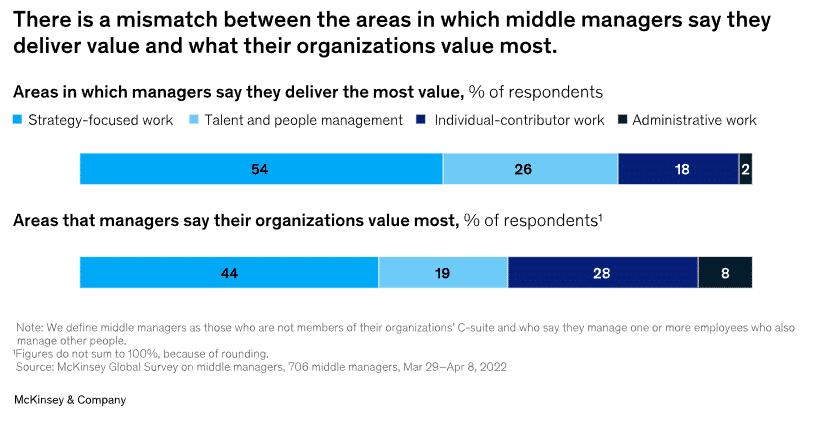
Whichever way you look at it, caught in the crossfire, or as a peacekeeper, the role of middle management is not always easy, especially if there is a disconnect between how they value their own contribution vs how the company values them. This disconnect is highlighted in a five-year study of managers by McKinsey & Company.
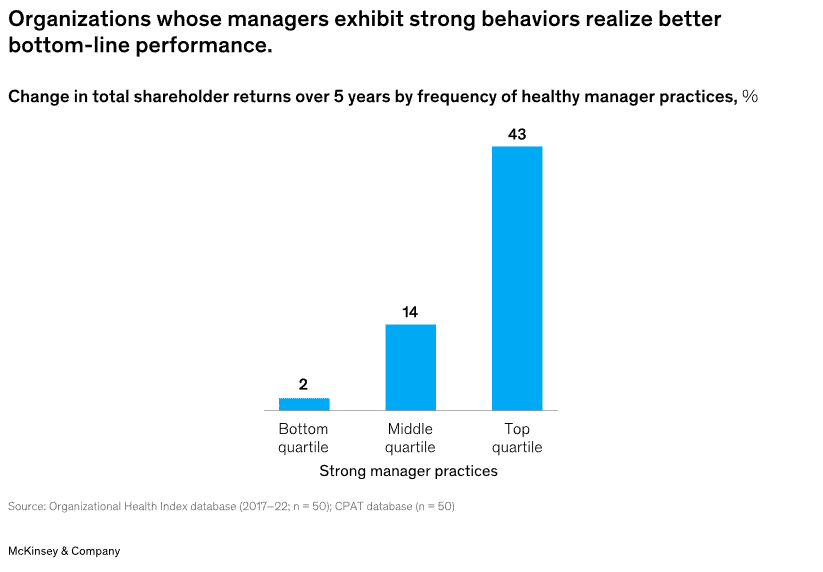
Another McKinsey study also showed that top-performing middle managers can have a direct and significant impact on a company’s financial outcome.
Furthermore, middle managers perform a vital role within their organisation; they are the key connectors, communicators and implementors that bridge the gap between corporate goals and strategy, senior management, and frontline employees. In fact, in many ways, middle management should be seen as the heart of an organisation.
So, you’d be forgiven for thinking that companies prioritise this group when rolling out communication skills training programmes for their staff. However, feedback from many of our clients tells us that this is not the case.
So, in this blog, we are going to dive deeper into the critical role played by middle managers and explain why corporate communication skills training should be at the top of the list for this important group of employees.
The role of middle managers in corporate communication
Middle managers play a pivotal part in corporate communication. Because they sit in the middle of the organisation, their role requires them to master both top-down communication – ensuring that strategic goals are translated into actionable tasks for their teams, and bottom-up communication – so that employee concerns, insights and voices are heard.
As the key point of contact between the ‘top’ and the ‘bottom’ of the business, middle managers must be able to build trust with a wide range of stakeholders.
They also need the skills to be able to simplify complex messages and tailor them for specific audiences – up, down and across the organisation.
In short, middle managers serve as the communication backbone of an organisation, ensuring information flows seamlessly and accurately in both directions. This is essential for ensuring strategic alignment, employee engagement, and team productivity. That’s a lot of responsibility!
Challenges of middle managers in internal communications

One of the biggest internal challenges facing middle managers is navigating between the expectations of senior leaders and the needs of employees. More often than not this can lead to mixed messaging, especially when tasked with implementing organisational change or where there is a conflict of priorities.
During periods of transformation (and let’s face it, transformation is now almost the new norm) communication is often rushed and not thought through due to time constraints and workload. Ambiguous communication can undermine the trust that employees feel towards managers, which in turn can lead to a loss of credibility. It can also erode employee confidence, team cohesion, and business efficiency.
So it’s not surprising that without the right tools and training middle managers often feel ill-equipped to deal with the challenges they face.
Skills middle managers need for effective communication

When you think about the skills that middle managers need, one obvious one comes to mind- being a good communicator. But there are also a number of other crucial skills they need to master in order to perform their role at the very top level.
- Active listening. This isn’t just about listening; it’s about understanding and comprehending, empathy and using one’s emotional intelligence. Being able to focus entirely on the speaker, letting them complete their thoughts without interruption and learning how to ask open-ended questions are all part of the art of active listening.
- Strong non-verbal communication skills. What we do when we speak or don’t speak can communicate more than we realise. Being aware of body language, ensuring the tone of voice is in keeping with the message and being fully present while others are speaking are skills that need to be mastered.
- Create a safe and neutral space for employees. Team members need to feel able to express concerns or offer ideas without fear of judgment. Middle managers must always stay neutral in order to resolve conflict and move difficult situations towards solutions.
- Be open to feedback. Encourage a culture where team members feel able to offer feedback and use this mechanism to reinforce people’s strengths and identify areas for improvement.
- Promote inclusivity. Making sure that all voices are heard, being aware of cultural norms and the different communication styles of team members.
- Master clear and concise messaging. Managers need to be able to simplify complex messages into actionable steps that are tailored to a wide range of audiences.
- Build storytelling techniques. Sharing anecdotes and personalising messages are a great way to motivate teams and bring important messages to life by making them relatable.
No doubt the most effective middle managers could add to this menu of requirements, but we think this is already a pretty daunting list. Most of these skills are not inherent for many of us, but the good news is that they can be taught.
Strategies for effective middle management communication
One of the most effective and immediate ways to boost the communication skills of middle managers is through professional training designed specifically for their role and their business. And the best communication training incorporates all of the skills that we covered above, and more.
10 key components for successful corporate communication skills training
- Understanding that different audiences want different things and how to tailor the content of the communication so that’s it’s meaningful and motivating for them.
- Techniques for creating an easy-to-follow communication narrative that brings the information to life in a clear, concise way – no matter how complex the information might be. Our SecondNature Presentation MapperTM is a fantastic framework designed specifically to help people develop outstanding communications and presentations quickly and effectively.
- Ways to include storytelling to influence and inspire audiences.
- How to create a positive first impression, establish credibility and the right to be heard, and quickly build listener rapport.
- How to kick off a presentation (or meeting) and get people’s attention right from the get-go.
- How to use Emotional Intelligence to pre-empt and manage people’s concerns, resistance, scepticism or negativity.
- Techniques to engage, involve and maintain audiences’ attention – in-person and online.
- Techniques for delivery success inc. harnessing voice, eye contact, body language, facial expressions, gestures, movement and closing a presentation.
- Thinking on one’s feet and answering questions with poise and control.
- Strategies for controlling nerves before and during a presentation.

In addition to communication skills training, it is essential that middle managers have appropriate support systems in place within the company. They require clarity from senior leaders to minimise ambiguity and ensure that directives are consistent and concise. They need to feel empowered enough so that they can adapt corporate strategies into meaningful goals for their teams and should have access to the tools and platforms that facilitate information flow and feedback mechanisms. By addressing these challenges, organisations can empower middle managers to communicate more effectively and help to build a more collaborative and aligned workplace.
How our communication training can improve the performance of middle management
Good communication and presentation skills are an essential part of ensuring that messages and actions – both up, down, and across the organisation – are consistent and clear. If you’d like to significantly improve the confidence and performance of those at the ‘heart of your company’ with training that is personalised to their development needs and tailored for your business, then why not get in touch?
For nearly 20 years we have been known as the Business Presentation Skills Experts, training and coaching thousands of people in an A-Z of global and local organisations.
View our presentation skills training and coaching reviews to check out what they say about our programmes. We have a wide range of customised corporate training solutions, both in-person and online to choose from, each of which can be tailored to your specific business needs.